What International Buyers Need from a Japanese Manufacturer’s Website
An international buyer arriving at a Japanese manufacturer’s website may not know the company’s place in the supply chain, the meaning of an internal process name, or whether an enquiry is appropriate. A useful English website does more than translate an equipment list. It helps the visitor understand what the company does, which facts support that position and what to ask next.
Connect each decision to approved evidence
Start with the intended reader and the decision a page should support. Then organise facts the business has approved for public use, conditions that need individual review and information that must remain confidential. This produces clearer content without turning a capability statement into an unconditional promise.
1. Define the buyer and the decision
An engineer may be checking process or material fit. A procurement lead may be looking for scope, quality context and the route to a conversation. An overseas business-development contact may first need to understand the company’s role and communication options. Give each page a primary reader and a useful next decision instead of putting every detail on the home page.
| Buyer question | Useful website information |
|---|---|
| What can we discuss? | The relationship between capabilities, processes and product groups, including relevant boundaries |
| Could this fit our requirement? | Approved context about materials, processes, quantities or dimensions where appropriate |
| How is quality approached? | Approved inspection or management information, its scope and a route for further questions |
| What should we send next? | Non-confidential information needed for an initial discussion and how sensitive material is handled |
| Can we communicate effectively? | Accurate language coverage, contact route and matters that require individual confirmation |
2. Explain the company’s role before listing machinery
State whether the business manufactures, processes, supplies, designs or coordinates—and where its responsibility sits in the wider process. Connect equipment and techniques to the kinds of questions they help address. Even where dimensions, drawings or customer identities cannot be public, a company can often explain its role, the relevant stages and how a requirement is reviewed.
3. Build a claim-and-evidence register
Words such as precise, fast, flexible and high quality are difficult to evaluate without conditions. Before publication, record the proposed claim, its evidence, its limits, the person who approves it and the review date. Any figures, certifications, equipment details or examples should be checked by the business for accuracy, currency, scope and permission to publish.
| Content area | Questions before publication |
|---|---|
| Capability range | Which materials, processes or volumes are covered, and what still requires review? |
| Equipment and techniques | Is the specification current, accurate and relevant to a buyer decision? |
| Quality information | Which site, process and period does it cover, and who approves the wording? |
| Projects and photography | Are customer, product, location, safety and contractual permissions clear? |
| Lead time and capacity | Which variables affect the answer, and should it wait for a quotation or technical review? |
4. Separate public, discussable and confidential information
Classify material as suitable for public release, available after the requirement is understood, or confidential. Choosing not to publish something is part of responsible information design. An initial enquiry form should not encourage visitors to upload confidential drawings or personal data without a suitable process; explain how sensitive material can be exchanged when it becomes necessary.
5. Add context before translating into English
An abbreviation or machine name understood internally may not carry the same meaning for an overseas reader. Establish the full term, its role in the process, relevant conditions and the decision it supports in the source material first. Then use terminology the audience is likely to recognise while keeping the company’s factual boundary intact. Japanese and English pages can use a different order or level of explanation without making different claims.
6. Treat images and drawings as evidence
Photography can make equipment, process, finish, inspection and team roles more tangible. It can also reveal a customer name, drawing, screen, badge or manufacturing condition. Record what each image is intended to demonstrate, whether it is approved for publication and who replaces it when it becomes outdated. Alternative text should communicate the image’s purpose in the page, not merely list visible objects.
7. Make the enquiry step specific and safe
Tell a visitor which non-confidential details help with an initial conversation and what the company needs to assess before responding. If feasibility, price or lead time depends on the project, do not turn it into a site-wide promise. A clear route can reduce uncertainty for the buyer while giving the manufacturer enough context to direct the enquiry responsibly.
8. Keep technical facts maintainable
Equipment, certifications, contacts and operating conditions change. Assign a content owner, review date and event that triggers a check for each important page. Compare the site with sales and recruitment materials as well. After publication, look beyond rankings: review the questions visitors ask, which pages contributed to those conversations and which information was still missing.
Manufacturing website content checklist
- Give each page a primary reader and decision to support.
- Explain the company’s role and connect capabilities to the relevant process.
- Record claims, evidence, conditions, approvers and review dates.
- Separate public, discussable and confidential information.
- Confirm accuracy and publication rights for figures, certifications, images and drawings.
- Add technical context before translating terminology.
- Design an enquiry route that does not casually collect confidential material.
- Assign an owner and a review trigger for changing technical facts.
Plan the English structure and the update workflow together
A multilingual site is not only a set of translated files. Decide how Japanese and English pages relate, who approves each language and where each enquiry should go.
MAKE TECHNICAL VALUE CLEAR
Build a route from approved technical facts to a useful conversation.
We can review the available capabilities, product information, evidence and enquiry flow, then shape a Japanese–English site structure for an unfamiliar buyer.
Review and article boundary
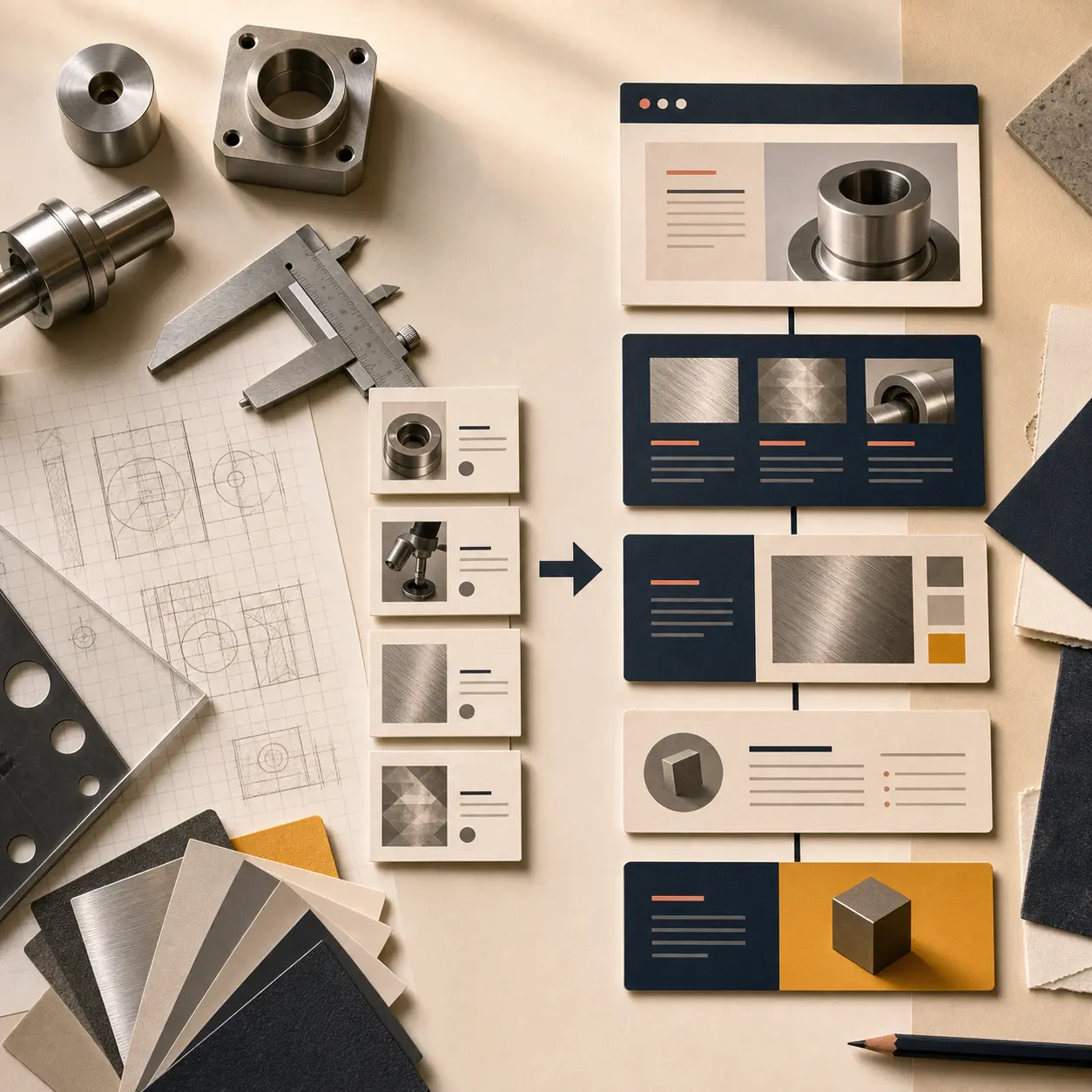
Reviewed 20 August 2026. This article covers general information design and publication checks for manufacturing websites. The components, drawing and measurements in the accompanying conceptual image do not represent a real client, product, machine, certification or test result. Each company must confirm its own technical facts, rights and commercial conditions.